Damnoen Saduak Floating Market In Thailand

Damnoen Saduak is located in Rachaburi province, around 100km from Bangkok.

This is default featured post 2 title

Go to Blogger edit html and find these sentences.Now replace these sentences with your own descriptions.

This is default featured post 3 title

Go to Blogger edit html and find these sentences.Now replace these sentences with your own descriptions.

This is default featured post 4 title

Go to Blogger edit html and find these sentences.Now replace these sentences with your own descriptions.

This is default featured post 5 title

Go to Blogger edit html and find these sentences.Now replace these sentences with your own descriptions.

Showing posts with label Heritage. Show all posts

Complex of Hue Monuments Hue Imperial City

Construction of the Imperial City started in 1805, under the reign of Emperor Gia Long, and was completed in 1832, under the reign of Emperor Minh Mang. Built on the northern bank of the Perfume River, the Imperial City was influenced by the style of French architect Vauban. The city comprises three sections: the Royal Citadel, the Imperial Enclosure and the Forbidden Purple City.

Complex of Hue Monuments Hue Imperial City
 
Royal Citadel Enclosure: The outermost boundary of the citadel has a perimeter of 9,950 m. The citadel has ten entrances: Nha Do Gate, Sap Gate, Ngan Gate, Thuong Tu Gate, Dong Ba Gate, Ke Trai Gate, Hau Gate, An Hoa Gate, Chanh Tay Gate, and Huu Gate
 
Imperial Enclosure (Hoang Thanh): The Imperial Enclosure of Complex of Hue Monuments Hue Imperial City is the second rampart with a perimeter of 2,450m. It is accessible through four gates: Ngo Mon to the south, Hoa Binh (Peace Gate) to the north, Hien Nhon (Humanity) to the east, and Chuong Duc (Virtue) to the west. Ngo Mon is the main entrance gate to the city and was formerly reserved for the passage of kings. 
 
Forbidden Purple City (Tu Cam Thanh): The third and innermost fort of the royal complex has a perimeter of 1,225m and is accessible through seven gates. It was formerly reserved for the private use of the kings and their families, as well as the numerous concubines. The Forbidden Purple City is almost isolated from the outside world. Located inside the three high ramparts and deep moats, is a large cluster of smaller structures built along a main axis that runs from south to north. The first structure is Ky Dai (Flag Tower). It is followed by Ngo Mon Gate, Dai Trieu Nghi Yard, Thai Hoa Palace, Can Chanh Palace, Khon Thai Palace, Kien Trung Palace and Hoa Binh (Peace) Gate.

Ngo Mon (Gate): This three-story structure is 58m long, 27.5m wide, 17m high, and serves as the main entrance to the Imperial City. Ngo Mon comprises five gates, with the central gate being reserved for the kings only. The two adjacent gates were exclusively for court officials, and the two other outer gates were used for servants and members of the royal entourage. On top of the arch is the Five Phoenix Pavilion where the king sat during festivities. This was also where ceremonies were organized to announce the names of successful candidates of royal examinations. During the reign of the Nguyen Kings, Ngo Mon was only opened when the kings were passing by or receiving foreign ambassadors.
 
Palace of Supreme Harmony (Dien Thai Hoa): Thai Hoa Palace was built in 1805 according to 19th century architectural designs for palaces and temples. It is composed of two buildings, the anterior palace and the main palace, which are joined together. This is where the golden throne of the king is located. Thai Hoa Palace was the most important building of the capital used for important court ceremonies.

Dynastic Temple (The Mieu): This was one of the many shrines and temples dedicated to the kings and royal members of the Nguyen Dynasty. It was built in 1921 to worship King Gia Long and was later used to worship his successors as well. Up to now ten kings are worshipped in The Mieu. The Mieu is comprised two separate halls, each furnished with an ornamented bed made of ironwood and covered with golden glaze and red lacquer, an altar, funerary tablets and precious military weapons used for worshipping purposes. This was where the court organized grand funeral services headed by the late king's successor. The Temple is said to be the largest shrine of this kind ever built in Viet Nam.
 
Nine Dynastic Urns: The Nine Dynastic Urns were cast between 1835 and 1837, and weigh between 1,900 to 2,601kg each. The whole row of urns represents the power and stability of the Nguyen Dynasty. These urns are the greatest achievements of the 19th century bronze casting in Viet Nam. Traditional ornamentation was chiselled on the sides of the urns, each dedicated to a particular emperor. The 17 designs, based on classic motifs, include the sun, the moon, clouds, mountains, rivers, and scenes from everyday life. Many consider the nine urns to be a real encyclopedia of the landscapes, farm products, and animals of Viet Nam.
 
Pavilion of Splendour (Hien Lam): Hien Lam Pavilion is a memorial pavilion built to remind younger generations of the merits and contributions of members of the Nguyen Dynasty. Like the Nguyen Kings who were worshipped in The Mieu, other memorable people and mandarins were worshipped in the two halls located on either side of Hien Lam Pavilion. Hien Lam Pavilion was built within the site of The Mieu and was made of wood. The three-story building, which is 25m high, is the tallest building in the whole Imperial Enclosure.
 
Royal Residence (Cung That): Cung That was reserved for the private use of kings and their families. This area was an important component of the Hue Imperial City, which included several palaces: Can Chanh Palace (King's Residence), Khon Thai Palace (Queen's Residence), Dien Tho Palace (King's mother's Residence), and Truong Sinh Palace (King's paternal grandmother's Residence). Unfortunately, most of the palaces were destroyed in the wars, with the exception of the Dien Tho and Truong Sinh Palaces.
 
Dien Tho Palace was built in 1804. A special feature of this architectural structure is the roofed corridor that links Dien Tho Palace to the king's residence to facilitate the King's visits to his mother. It was restored as its old design.
 
Complex of Hue Monuments Hue Imperial City.

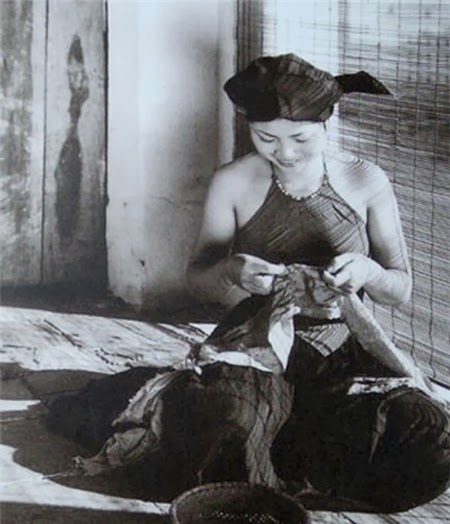
Hanoi Women's Clothes At The End Of The 19th Century

Hanoi oldday Women's ClothesIn the past for convenience at work, Hanoi women wore a brown, round-necked, mostly unbuttoned tunic outside a brown plastron. The plastron is a square piece of fabric or silk put diagonally across the chest, one corner is cut into a round or V-shaped neck. The plastron is tied to the body by two straps at the neck and two at the waist.

For the bottom part, they wore a below-the-knee skirt, an held it by a floss silk belt wound around the hip once or many times, usually in a brown or olive color. In winter, they simply put on additional tunics; old people wore short black cotton-padded coats.

For going out, they put on an outer robe with four flaps, which is open without buttons, and the two front flaps are usually bound together. Alternatively, they could choose a five-flap dress with 3 front flaps, one shorter than the others. The latter had buttons from the neck down to the hip. Their long turbaned hair was around the head. The turban is a 3.5x1 foot fabric strip, in black or brown. To make a round, thick hair roll, they padded it with a 1.5 foot long ctton-stuffed roll; a string at the end of the roll was as long as the roll itself and helped to keep the hair in place. The first step to roll the hair was to part their hair in the middle, then put it all to one side, usually the left, put the pad roll inside as the core, then wind the string around the hair before wrapping the hair with the turban. After fixing the turban with a pin at the end, the woman would comb the hair roll length-wise to make sure it is neat. The she would put the hair roll around the head and slilde the end under the roll. If the hair is longer than the turban, the last tuft of the hair will be curved like a cock’s tail above the left ear. Such curved hair tuft was the most popular hair style, hence the old saying “Ten reasons to love a girl”:

“First is love for the protruding tuft of hair
Second is love for graceful talking"

Most women wore round silver ear-rings delicately carved by the silversmiths, rich ones wore gold ear-rings.

To cope up with the coldness in winter, women covered their heads with a black shawl, a square piece of fabric; each side is seventy to eighty centimeters long. A shawl should be folded diagonally, cover the ears and fastened under the chin.
Hanoi oldday Women's Clothes 2

Festival clothing was the same style as daily clothing, but more colorful. A three-layer dress included a four-flap robe made of brown, black or deep purple chiffon, the second and the third layers were yellowish, lotus-pink, or green. The dresses were round-necked with straight flaps. Only buttons at the side were fastened, while the ones from the neck to the armpit are left open to reveal the three dress layers in three colors. Inside the dress, women wore a V-necked tunic, and a rad plastron. Some used to put on an olive or peach silk belt as a highlight.

Using matching colors, long-straight robes, the ladies made the outfit so eye-catching but still decent. One important part of such festival outfits was the seven-length fine silk or floss-silk skirt. The lower hem balloons out like a wave; the upper hem was wide, always in bright colors such as green, pink, lime or yellow. The skirt's black body was the background for the colorful silk belts. The ladies would not forget to hang on their belts a silver key chain that held a silver lime container (for eating betel leaves and areca nuts), a small horn-handled sliver knife to cut areca nut which are also considered jewelry, and a peach-shaped box containing tobacco or betel-nuts.

For footwear, ordinary women walked barefoot in daily life. Only during long distance trips, did they wear flip-flops made from buffalo skin with cow-skin straps, similar to Thailand's flip-flops today.

For urban wealthy women, the traditional outfit was the same, just more sophisticated in color, better sewn from more expensive fabric. For example, the plastron's necks were rounded and sewn much better; the stitches looked like they were sewn by a sewing machine. On Hàng Đào street in Hanoi, house no.38, there was even a tailor specializing in sewing ready-to-wear plastron neck. For the tunic, they used 100% white silk. The turbans were mostly made from black velvet. All outer robes had five flaps, made of chiffon, gauze, etc. In winter, the favorite materials were smooth or printed brocade, or thick cotton, lined with blue or grey silk. Later on, urban ladies stopped wearing skirts and wore black satin trousers, with pink or olive-green upper hems. On holidays, they used to put on gold necklaces, the length depending on how rich they were, and gold bracelets or xuyến. Xuyến, a kind of flat bracelet with two ends hooked together, so that the user might adjust it ti fit her arm. Xuyến can be smooth or carved. Urban rich ladies did not wear round ear-rings but long, delicate gold ear-rings. The put on high-heeled leather sandals or embroidered shoes.

However, in 20th century the fashion for Hanoi women has changed dramatically. With urbanization changing the face of Hanoi, the clothes, jewelry, accessories and fabrics have changed and a "New Fashion" style has emerged. 

Hanoi Women's Clothes At The End Of The 19th Century.

Twitter Delicious Facebook Digg Stumbleupon Favorites More